
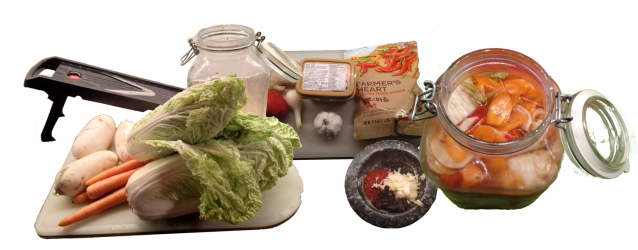
Korean sauerkraut kimchi is real super-food. The main ingredients are napa cabbage (Chinese cabbage) and radish (Kor. mu, Jap. daikon). Practically almost any vegetable can me amended to the recipe. Kimchi is seasoned with ground chili pepper “gochugaru”, ginger, onions and garlic. The recipes may also contain seaweed or fish sauce. Gochugaru has a relatively mild taste. If you use other types of red pepper (fresh or ground), be careful with dosing. Do realize however that kimchi should taste spicy and fresh, as it is used as a side dish. It is essential to use clean vessels and raw materials and to use enough salt. The salt content in the final product should be 20 to 30 g per litre. The organisms responsible for lactic acid fermentation grow on the surface or inside of the vegatables. Therefore it is important not to heat them. I dissolve salt into boiling water (50 g per 1.5 L water) and let it cool overnight. Then I add the vegetables and macerate them one day in the salt water. I pour the water off and save it for further use. The vegetables are packed in layers to the fermentation (preservation) jar with the spice slurry. After re-filling, I return most of the salt water to the jar and use a wooden club to compress the contents and to drive out excess air. Take care that all the ingredients will be covered by liquid. Put a piece of plastics and something heavy (e.g. drinking glass filled with salt water) on the top. Ferment kimchi 4 days at room temperature, then place the jar into fridge.
The science behind
Lactic acid fermentation is a traditional as safe method for food preservation. Vegetables contain many types of microorganisms. As they start to grow, oxygen is fast depleted and lactic acid bacteria (especially Leuconostoc species) start to rule the environment. They produce carbon dioxide and lactic acid, which drops the pH and kills harmful bacteria. Some LAB species are also known to produce bactericidal compounds. Since oxygen-free environment is required, the fermented foodstuff should be covered by a liquid layer. I like to use preservation jars which can be closed air-tight, as they help to maintain the CO2-environment. Since CO2-gas is formed in the process, you should occasionally let the excess pressure out. Although vegetables contain only a low amount of fermentable sugars, some pressure may be formed.
Ingredients
- 1.5 kg napa cabbage
- 0.5 kg radish
- ½ onion, 5 middle size carrots, 1 paprika or another colourful vegetable
- 5-7 garlic cloves
- ginger (size which equals 2 thumbs)
- 2 to 3 tbsp ground chili pepper ”gochugaru”
- 2 tsp (10 ml) fermented soy paste or 2 tbsp (30 ml) soy sauce.
Procedure
- Prepare the brine (50 g seasalt, 1 ½ L water). Heat and let cool properly.
- Cut napa cabbage into 5 cm thick pieces. Peel and slice radish and carrots with mandolino (veggie cutter). Chop onion and paprika.
- Pack the veggies into preservation jar. If you use an airtight preservation jar, you can keep it half time upside down to ensure even maceration.
- Next day prepare the spice slurry. Grate the peeled ginger and garlic cloves into mortar. Add gochugaru (chili) and fermented soy bean paste, and grind everything with a pestle to an even slurry.
- Empty the jar and pack the veggies back in layers by rubbing the spice slurry onto every layer.
- Finally compress the contents with a wooden club and add enough brine to cover all the content.
- Add a piece of plastics and something heavy (e.g. glass filled with brine) to ensure that kimchi will not be exposed to air. Ferment for 3 to 4 days and transfer the jar into fridge.
The microbial quality of kimchi allows instant consumption, but the vegetables continue softening and the flavour intensifying, if you let it stand in fridge a week or two.

 Dine with a Vegan
Yum! This sounds great!
TykkääTykkää