
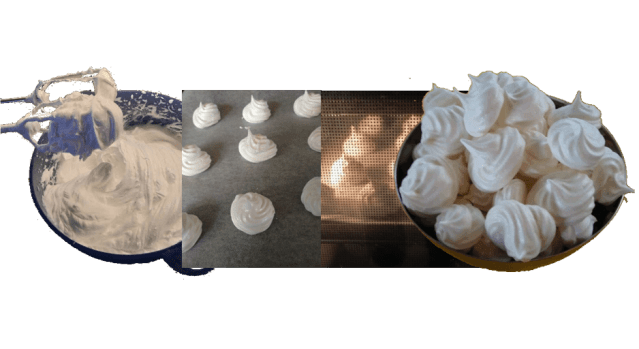
Egg white in meringue can be substituted with aquafaba, the broth of canned beans. Although basically any bean broth can be used, the best result is obtained with chickpea broth. The broth should be chilled prior to whisking – do not even consider the possibility to make Swiss or Italian type of meringue with aquafaba! Addition of vinegar (white wine vinegar) or lemon juice enhances the formation of protein foam. It is advisable to add a little bit starch (corn, potato or oat starch) to sugar to strengthen the meringue structure. You have to whisk aquafaba quite long (5-10 min) before sugar addition. However, unlike with egg white, there is no risk at all to whisk too much. The recipe below will give you roughly 50 meringue cookies. I have used a can containing 400 g drained chickpeas and 140 g broth. You can re-scale the recipe according to your ingredients.
Ingredients
- 1.4 dl broth from chickpea can.
- 2 tsp white wine vinegar or lemon juice
- n. 250 g caster sugar
- 2 tsp vanilla sugar or few drops of vanilla aroma
- 2 tsp starch (corn, potato or oat starch)
Procedure
- Harvest the brine from chickpea can, note the most proteinaceous (slimy) material is released last. Use the chickpeas for example for hummus.
- Let the brine cool down in a fridge.
- Add wine vinegar and whip until the foam is firm.
- Mix starch with sugar, and add gradually to the foam while whipping vigorously.
- The foam is about ready when it becomes somewhat sticky.
- Transfer the meringue into a piping bag and extrude blobs with a 3 to 4 cm (1.5 inch) diameter onto a baking tray covered with a baking paper.
- Bake at 110-120 oC for at leat 4 h without opening the oven. Let the meringues cool down in the oven.
Use the vegan meringues for small pavlovas or crumble them for a Eton mess type of dessert. You can also prepare tiny snowmen by making the meringues higher and decorating them with black and orange edible gel dyes.
 Dine with a Vegan